

Easter 2026
By Hans Casteels. A knife, a cottage, a beige dog, and just enough family truth to keep Easter interesting

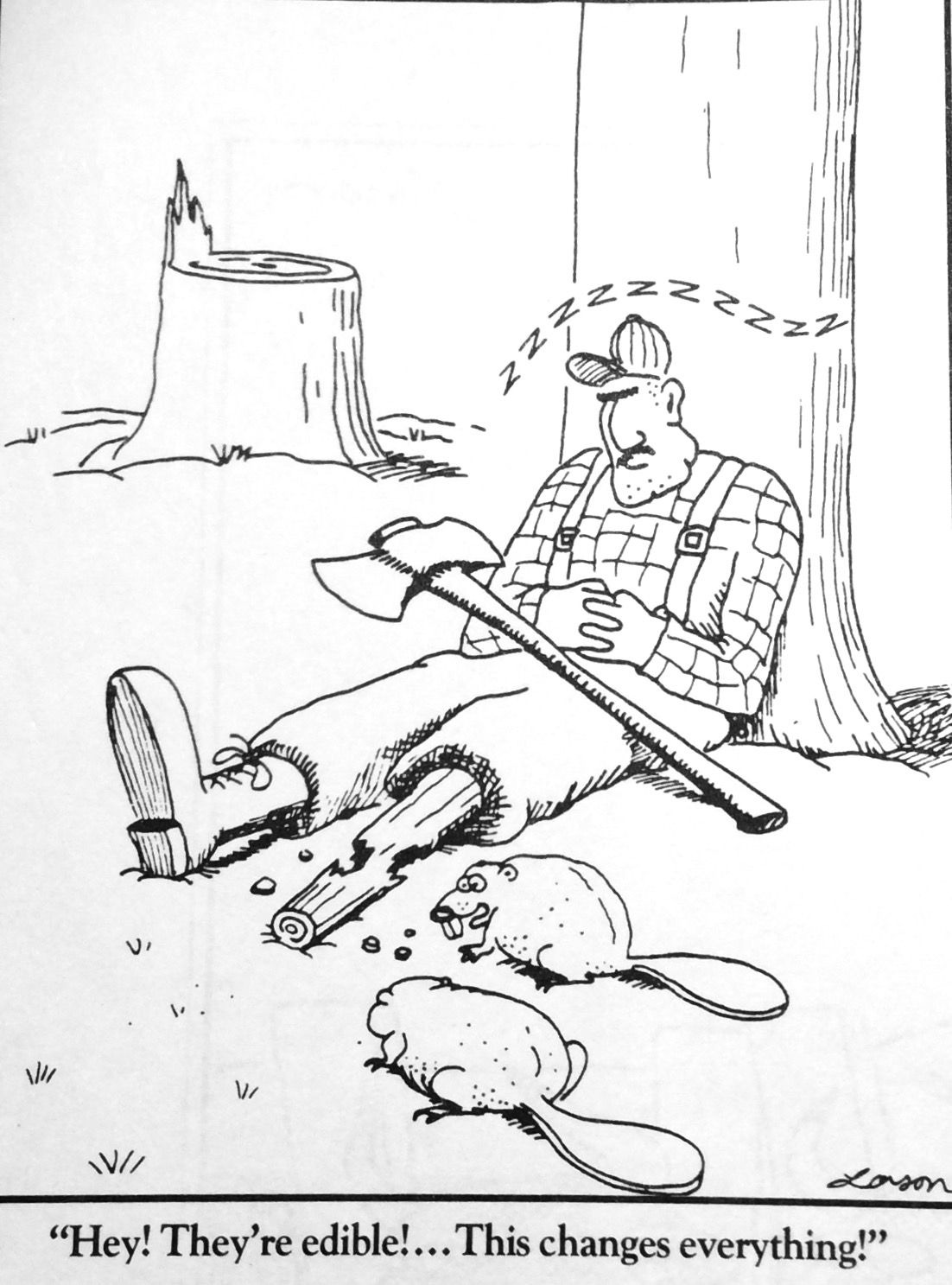
Easter, for most people, is marketed as a gentle combination of chocolate, renewal, and overcooked lamb, the culinary equivalent of playing it safe in a world that clearly does not reward restraint. I once disrupted this fragile illusion by serving rabbit, which my children have treated ever since as a personal betrayal rather than a menu choice. In their version of events, Easter is not about resurrection but about the time I casually introduced them to the uncomfortable reality that the animal on the plate once had a face. Forgiveness, it turns out, is highly selective and does not extend to anyone who interferes with tradition, especially if that tradition involves pretending that lamb somehow materializes in neat, anonymous portions.
In reality, Easter functions less as a celebration and more as an annual stress test disguised with pastel colors and sugar. It is the one day of the year where families voluntarily assemble to confirm that time has changed absolutely nothing except the price of groceries and the level of denial required to get through dinner without someone revisiting a topic that should have been buried around the same time as the chocolate eggs. You sit down with people you love, people you tolerate, and people you are still trying to figure out, and collectively agree to behave like a functional unit for several consecutive hours, which is an ambition that would impress even the most optimistic systems designer.
Easter 2026 did not disappoint. It delivered exactly what was promised, which is to say chaos, minor injury, questionable decisions, and a reminder that no matter how far you travel geographically, your family will always find you. They arrive with luggage, opinions, and a casual confidence that whatever system you have in place will bend to accommodate them. It is less a visit and more a reoccupation, conducted politely but thoroughly, like a well meaning invasion that leaves behind stories, dishes, and the faint suspicion that normal life will resume only after a period of quiet recovery.
There is also something uniquely revealing about the way Easter compresses expectations into a single day. It demands good food, good mood, good weather, and good behavior, all at once, which is ambitious given that most households struggle to achieve one of those on a consistent basis. The result is a kind of performative harmony where everyone does their best impression of civility while small cracks appear at the edges, usually over something trivial like seating arrangements or the correct way to cook vegetables. These are not really arguments about vegetables, of course. They are placeholders for a lifetime of accumulated preferences, grievances, and the occasional power struggle over who gets to define what “normal” looks like this year.
And yet, for all of its absurdity, there is a strange reliability to it. Easter does exactly what it has always done. It gathers people, exposes dynamics, tests patience, and somehow lands on the other side with everyone agreeing that it was, on balance, a success. Not because it was flawless, but because it was familiar. Because beneath the chaos and the occasional questionable protein choice, there is a shared understanding that this is what we do. We show up, we eat, we navigate each other carefully, and we leave with enough material to carry us to the next gathering, where we will once again act surprised that nothing has really changed at all.
The opening act began, as all great tragedies do, in the kitchen. There is something about a kitchen that gives people an inflated sense of competence. When I was in my exuberant youth, I had wanted to be, and thus I used to be, a chef, which makes this next part particularly humiliating. In a moment of what can only be described as gravitational curiosity, I managed to drop a chef’s knife off the counter and guide it, with surgical precision, straight into my foot. Not near the foot. Not beside the foot. Directly into it. If you are wondering whether a kitchen knife can produce immediate and impressive blood loss, the answer is yes, enthusiastically so. The floor looked like a low budget crime scene, and for a brief moment I considered whether I should just lean into it and let the family think Easter had taken a darker, more interesting turn.
Enter my daughter, the NICU nurse, who has spent her professional life dealing with fragile humans and somehow found herself at home dealing with me. She moved into action with the efficiency of someone who has seen worse, which was both comforting and mildly insulting. Her husband, who remains a fascinating case study in how adulthood can be optional, hovered nearby in what I assume was emotional support mode, which looked suspiciously like doing absolutely nothing while nodding. She applied pressure, issued instructions, and generally prevented me from bleeding out on a holiday that already had enough symbolism around death and resurrection without me contributing personally.
Meanwhile, the rest of the family adopted the traditional role of cheerful bystanders. There is always a group that believes optimism is a medical intervention. “It will be fine,” they said, in the same tone one might use to reassure someone whose soufflé has collapsed, not someone actively leaking onto the tile. It is remarkable how quickly people will normalize a situation once they decide it is inconvenient to escalate it. Blood on the floor becomes “a bit of a mess.” A knife in the foot becomes “a small accident.” By dessert, I suspect it would have been rebranded as “a learning opportunity.”
And because no family gathering is complete without introducing a completely unrelated life decision, this was also the moment we collectively decided to get another dog. Not just any dog, but a Newfoundland, because clearly what this household needed was more mass, more fur, and more responsibility. This particular Newfoundland comes with two recessive genes, which in dog breeding circles translates into a beige coat and, apparently, social exile. The Newfoundland purists have decided that beige is unacceptable, which tells you everything you need to know about any group that looks at a giant, gentle dog and says, “Yes, but the color is wrong.” Naturally, this made the decision easier. If there is one thing we excel at, it is adopting the underdog, or in this case, the under colored. Her name will be Isabel, because every large, slightly unconventional dog deserves a name that sounds like she might also own a vineyard.
There were, of course, immediate promises of shared responsibility. Everyone will walk her. Everyone will help. Everyone will contribute. This is the same script that has been performed in households since the invention of domesticated animals. It has a predictable third act in which one person ends up doing all the work while the others occasionally say, “She really loves you,” as if that explains why they have disappeared entirely from the walking schedule. I look forward to Isabel bonding deeply with me while the rest of the family bonds with the idea of having a dog.
Adding to the festive atmosphere was the ongoing subplot involving my son, who remains somewhere in Southern Ontario, which is less a location and more a mood. He is, by all available evidence, hiding. This narrows it down to approximately every town in the region. Sharon, understandably, is not thrilled about this arrangement, though experience suggests that this will resolve itself in the usual way, which is to say it will fade into the background as the next family issue takes center stage. Families do not solve problems so much as rotate them.
Then there are the twins, the outcome of a well intentioned parental collaboration between my second wife and her third husband, which already tells you this is not going to be a straightforward story. They have elevated complaining into a performance art that deserves public funding. They are being asked/told to go north to a cottage, which in adult language translates to peace, quiet, fresh air, and the radical concept of hearing your own thoughts. In their language, it translates to exile. No immediate access to anything, no crowds, no noise, no WiFi that can support their very demanding relationship with short videos of strangers dancing. Just trees, water, and the creeping realization that boredom might require effort to solve. This, to them, is an outrage of historic proportions.
Of course, the cottage itself is exactly what people in cities fantasize about while paying unreasonable rent to hear their neighbor sneeze through drywall. It sits in the middle of nowhere, which sounds poetic until you need milk or a charger or any of the thousand invisible conveniences modern life has trained us to expect within six minutes. Then it becomes a logistical exercise that would impress a military planner. You do not “pop out” for anything. You commit. You plan. You reconsider your entire consumption strategy because forgetting one item means a 40 minute drive and a mild identity crisis.
What makes this particular Easter subplot more interesting, and by interesting I mean mildly surreal, is the small detail that the twins’ understanding of family structure is… flexible. They believe their mother is their mother, which is a reasonable assumption in most households and generally a safe bet. In this one, however, reality has taken a more creative route. Their half-sister is, in fact, their mother. Do not ask. There are timelines, decisions, and explanations that exist, but Easter dinner is not the venue for a whiteboard session. So everyone carries on, politely stepping around this detail like it is an extension cord in the middle of the room. You see it, you register it, and you choose not to trip over it publicly.
The result is a kind of layered absurdity where the twins are protesting a trip to a quiet cottage while unknowingly participating in a family structure that would confuse a seasoned sociologist. They are outraged about emerging mosquitoes and limited bandwidth, blissfully unaware that the real story sitting at the table could fuel an entire season of prestige television. But that is the beauty of families. What is extraordinary to an outsider becomes background noise to the people living inside it. The unusual becomes routine, the complicated becomes “just the way things are,” and the only thing anyone can agree on is that the cottage still has terrible reception.
And hovering over all of this, like a surprisingly competent stage manager, was my mood, which had taken a sharp and unexpected turn for the better. The week before had featured what I have come to call a PSA scanxiety episode, that delightful period where you wait for a number to arrive and mentally rehearse every possible outcome, most of which are unhelpful and none of which improve the actual number. This time, however, the result came back and instead of spiraling, it landed as relief. Not subtle relief. The kind that immediately translates into appetite, ambition, and the irrational belief that you can now outcook your past self.
Every good PSA reading deserves a good meal. That is not medical advice, but it should be. It shifts something fundamental. The kitchen stops being a place of obligation and becomes a stage again. Ingredients look more cooperative. Timing feels less like a threat and more like a suggestion. You start planning dishes that have no business being attempted on a holiday already overloaded with variables, because confidence has returned and it would like to express itself through butter and heat.
Which, in retrospect, makes the knife incident feel less like an accident and more like a narrative correction. There I was, newly energized, ready to deliver a meal worthy of the moment, and the universe gently reminded me that ambition should occasionally be accompanied by attention to gravity. Nothing recalibrates culinary enthusiasm quite like introducing a chef’s knife to your own foot. It does, however, sharpen the appreciation for the meal that eventually makes it to the table, prepared under less than ideal circumstances, surrounded by people who are simultaneously the source of the chaos and the reason you bothered in the first place.
For the rest of us, watching this unfold is both educational and oddly reassuring. Perspective, as it turns out, is not just about appreciating a lakeside sunset or a decent lab result. It is about recognizing that every family has its own version of normal, its own quiet agreements about what will and will not be discussed, and its own ability to focus intensely on minor inconveniences while casually ignoring the kind of plot twist that would make a novelist sit up and take notes. And if that is not Easter in a nutshell, nothing is.
Hovering over all of this was the local church, which was absolutely packed for Easter services. It was a reassuring sight if you believe in faith, and a fascinating one if you believe in risk management. There is a certain logic to showing up on Easter just in case. A kind of annual check in. “Hello, just making sure we are still on good terms.” Given the current state of global leadership, one can hardly blame people for hedging their bets. When the world feels like it is being managed by individuals who treat stability as an optional feature, a full church begins to look less like devotion and more like a contingency plan.
By the time dinner was served, the bleeding had stopped, the dog had been named, the family dynamics had been thoroughly exercised, and the collective agreement was that everything had gone well. This is the true miracle of Easter, not resurrection, but revision. The ability of a group of people to look at a day that included minor injury, emotional tension, questionable decisions, and declare it a success because nobody required an ambulance (well, that one was iffy) and the food was edible, or so I was told.
Easter does not bring out the best in families. It brings out the most honest version. The one where competence and chaos coexist, where love is expressed through both care and irritation, and where every gathering feels like a rehearsal for something no one has fully defined. It is messy, occasionally painful, frequently absurd, and, if you are paying attention, very funny. Which is fortunate, because if you cannot laugh at a day that involves a knife through your foot and a spontaneous decision to adopt a beige Newfoundland named Isabel, then you are left with taking it seriously, and that would be the real tragedy.
On another note, If I May… For those of you who read these posts regularly, you may have noticed something missing from this Substack: a paywall. There isn’t one. There never will be. I have no interest in charging people to read about cancer, life, absurdity, or whatever strange thought wandered into my head while drinking coffee and trying to make sense of the world. Knowledge, stories, and the occasional sarcastic rant should circulate freely.
But there is something I ask in return, and it has nothing to do with me.
My daughter Ashley works as a NICU nurse at William Osler Health Centre. Every shift she and her colleagues care for premature and medically fragile newborns who arrived in the world a little earlier and a little smaller than planned. These babies start life in equipment most of us never think about. Among the simplest and most essential pieces are NICU bassinets, the tiny first beds where very small humans begin their fight to grow, breathe, and eventually go home.
I started a GoFundMe campaign to help purchase new bassinets for the unit. Writing is both a means to keep my mind sharp-ish, and to help fund this initiative. At the beginning donations flowed generously, as they often do when people first hear about something worthwhile. Recently, however, the momentum has slowed a little. That is normal. The internet is a busy place and attention wanders off to the next shiny object.
Premature babies, unfortunately, do not wait for fundraising momentum to return.
So here is my modest proposal. If you enjoy reading these essays, if you appreciate having access to them without subscriptions, paywalls, premium tiers, or other digital toll booths, please consider making a voluntary contribution to the NICU bassinet fundraiser instead. Think of it not as paying for content, but as helping provide the first bed a newborn may ever sleep in.
If you have already donated, thank you. Truly. If you were planning to but never quite got around to it, this is a friendly nudge from the corner of the internet where sarcasm and stubborn optimism still coexist. The essays will remain free. But the bassinets, unfortunately, are not.
I feel compelled to share my one and only rabbit-related culinary story. We were visiting friends in an area of Spain very close to Nice, France by train, and the village had been home, at least part-time to paint artists of some acclaim, such as Dali & Picasso at one time or another. It was known to likewise attract similar aspiring artists from various countries, etc., etc. One young woman told the story of inviting a young Russian painter to their home for dinner, who offered to provide the meat for for the supper, and promised to deliver it early afternoon, and did so in a carefully wrapped paper bag. She opened the bag to see what he had delivered, and found several cuts of meat, and a separate bag that when she opened the bag, held a very large rabbit head, snipped off at the base of the neck, fairly recently, and completely undressed. She was a bit shaken and put it back in the bag and put it into the refrigerator. When the Russian artist arrived for dinner, she didn't mention the rabbit head until they were midway through dinner, and she finally brought it up, noting that she did not serve it because she had no idea how to prepare or cook such a thing. The artist broke into laughter and apologized, saying he forgot that it was in the bag, and that his intention was to was bury the head in his yard until everything had basically fallen away from the skull to the point where he could scrape the skull without difficulty, dry it, and it could serve as a model for his painting. Intriguing.
Brillant-so glad I chose your post first before the doomscrolling! The dog decision-congrats-she will be loved...my husband and I have our own Easter tradition-denial-however we chose The Life of Brian by Monty Python with burgers and fries for dinner this year! No Chocolate bunnies were harmed....Peace Out!