

The Experts Are Still Debating. Your Cancer Isn’t. Britain Says Wait. Australia Says Test. Your Prostate Says Good Luck. How Are Men Supposed to Know When the Experts Don’t?
By Hans Casteels, getting more confused by "medical wisdom" every day.

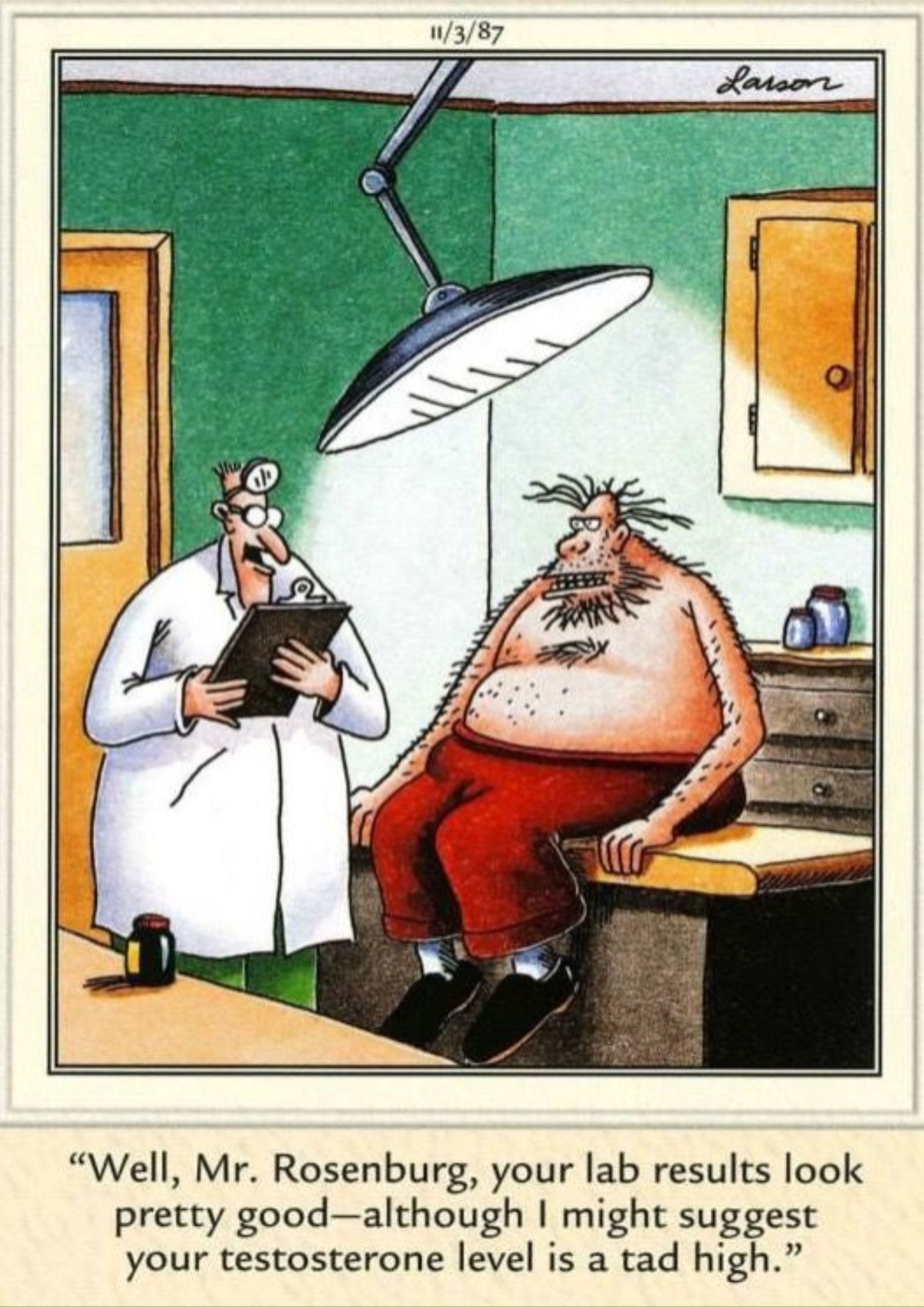
There comes a moment in every sophisticated civilization when a man approaching fifty should apparently stop whatever he is doing, locate an atlas and determine what his prostate believes about international borders. If he is standing in Australia, someone should probably stick a needle in his arm and establish a PSA baseline. If he is standing in Britain, the government would prefer considerably more restraint unless he happens to possess the correct genetic mutation and family history. Same gland. Same cancer. Same PSA molecule. Different hemisphere. Apparently prostate biology observes customs regulations.
Australia has introduced new clinical guidance under which men from 45 can begin PSA testing, with regular testing generally recommended from 50 through 69 and earlier regular testing for men at higher risk. Britain, meanwhile, reviewed essentially the same disease, the same test and much of the same international evidence and decided against population screening, concluding that screening ordinary asymptomatic men could still cause more harm than good. The British will screen a very specific group of men carrying a BRCA2 mutation plus the appropriate family history. Everybody else gets something medicine has perfected over several centuries: an informed discussion in which two people stare thoughtfully at one another while nobody actually tells you what the hell you should do.
This would be merely amusing if we were discussing whether butter belongs in the refrigerator. We are discussing a cancer that kills thousands of men every year. Britain records roughly 55,000 new cases annually and about 12,000 deaths. Australia diagnoses about 28,000 men a year and loses nearly 4,000. These are not obscure numbers involving a disease contracted exclusively by Lithuanian accordion repairmen. Prostate cancer is one of the most common cancers affecting men. Yet after several decades of research, the official international guidance still resembles four Belgian bureaucrats arguing over which form is required to obtain the form that explains the form.
And now the evidence itself has moved. In May 2026, Cochrane published an updated analysis involving nearly 800,000 men and concluded that PSA screening probably does reduce the chances of dying from prostate cancer. About two prostate cancer deaths are prevented for every thousand men screened over long follow up. Screening may also prevent about five metastatic diagnoses per thousand. Those numbers are not spectacular until you remember that one of those numbers might someday contain your name. Public health researchers see two deaths prevented per thousand and reasonably ask what happened to the other 998 men. The man whose metastatic prostate cancer was prevented tends to approach the arithmetic with somewhat less statistical detachment.
The problem is that screening also finds cancer that does not need finding. The same Cochrane review found approximately 36 additional prostate cancers for every thousand men screened. Some of them matter enormously. Some would have spent the next twenty years sitting quietly inside the prostate doing approximately what an elderly Belgian uncle does at a wedding: occupying space, occasionally making itself known and otherwise causing no particular difficulty. Medicine cannot always tell perfectly which one you have. That distinction is the entire argument.
And just to make the whole business even less tidy, PSA itself refuses to behave like the clean numerical verdict we desperately want it to be. A low PSA does not guarantee that you do not have prostate cancer, particularly when something else is waving a red flag. I know this personally. Years before my diagnosis, my PSA was around 1.0, a number sufficiently reassuring that everyone could have gone home for lunch, except I was having blood in my semen. Hematospermia is usually caused by something benign and by itself does not mean prostate cancer, but symptoms and clinical findings still matter even when the laboratory number looks beautiful. Some prostate cancers produce surprisingly little PSA, while at the other end of this ridiculous spectrum a man can have a PSA above the nominally “normal” range and have no cancer whatsoever. Benign prostate enlargement, prostatitis, urinary infection, ejaculation, recent instrumentation and even vigorous cycling can push PSA upward. So we have constructed a screening argument around a blood test whose result is neither a cancer diagnosis when it is high nor an all clear when it is low. PSA is not a verdict. It is one piece of evidence, and treating the number while ignoring the man attached to it is precisely how supposedly reassuring medicine can become dangerously reassuring.
Britain looks at those additional diagnoses and sees biopsies, anxiety, unnecessary treatment, erectile dysfunction and urinary incontinence inflicted on men whose cancers might never have bothered them. Australia looks at the men whose cancers will eventually escape the prostate and says perhaps finding the bastard before it reaches the bones has some merit. Neither argument is idiotic. That is precisely what makes this so infuriating, because the patient does not get to live inside the statistical model. The patient gets one prostate.
This is where phrases such as “population benefit” become wonderfully clean and useless. Population health must decide whether testing ten million men produces more benefit than harm across ten million men. I understand that. Governments have finite money, MRI machines, urologists and operating rooms. Somebody has to calculate whether spending billions testing healthy men produces sufficient benefit. That is legitimate public policy. But individual medicine asks a different question: should I get a PSA test? And suddenly the magnificent machinery of evidence based medicine begins coughing.
Ask Britain and the answer is essentially that routine population screening is not justified. Ask Australia and the answer increasingly becomes that a man should establish his PSA status much earlier, particularly once he reaches 45 or 50. Ask an American medical society and you may receive another age range wrapped in the phrase “shared decision making,” which is medical English for “we have transferred the uncertainty to you and would now like you to sign here.”
Shared decision making sounds wonderfully democratic until you consider the participants. On one side sits a physician who has spent perhaps fifteen years studying medicine. On the other sits Kevin, 52, who came in because his wife made the appointment and who thought PSA might be something added to gasoline. Kevin is now asked to weigh lead time bias, overdiagnosis, competing mortality, metastatic risk, false positives, MRI sensitivity, biopsy complications, family history and his personal preference regarding future erectile function. He has eleven minutes because somebody with hypertension is waiting outside. This, apparently, is empowerment.
The argument against screening also carries a historical burden that deserves more attention. Much of the fear surrounding PSA screening comes from an era when an elevated PSA could begin a medical conveyor belt. Elevated PSA. Biopsy. Cancer. Surgery or radiation. Congratulations, we removed a tumour that might never have killed you and introduced you to adult diapers.
But diagnostic medicine has changed. Multiparametric MRI can help determine who actually needs biopsy. Biopsies can be targeted. Risk classification has improved. Genomic testing is emerging. Low risk prostate cancer is increasingly managed with active surveillance rather than immediate treatment. We have spent twenty years making the consequences of finding an elevated PSA less stupid, which ought logically to alter the calculation about whether finding elevated PSA is itself stupid. Australia appears to believe it has. Britain is not yet convinced.
And this is where ordinary men have every right to become irritated with the priesthood of certainty surrounding medical guidelines. We are repeatedly told to “follow the science,” as though science were a Labrador retriever walking obediently six feet ahead on a leash. Science is not a set of commandments. It is evidence being argued over by intelligent people who may reach different conclusions because they assign different values to different outcomes. How much impotence equals one life saved? How many unnecessary biopsies are acceptable to prevent one metastatic cancer? How many harmless cancers can we discover before screening becomes harmful? How much uncertainty should a healthy 48 year old accept today to avoid discovering at 58 that something might have been visible ten years earlier? There is no laboratory test for those questions. They are value judgments wearing statistical clothing.
And perhaps that is what health authorities should finally admit. Instead of telling men that screening is either sensible or harmful, explain the damned trade. PSA screening appears to reduce prostate cancer mortality modestly. It also creates additional diagnoses, some unnecessary. Modern MRI and active surveillance probably reduce some of the historical harms, although we do not yet possess decades of mortality data proving exactly how much. Your age matters. Your family history matters. Your ancestry matters. Your genetics matter. Your life expectancy matters. Your symptoms matter. Your previous PSA matters, and perhaps most importantly, the direction in which that PSA is moving matters. Then let the man decide.
What seems increasingly indefensible is keeping men ignorant because somebody fears what might happen after the test. If overtreatment is the problem, fix overtreatment. If unnecessary biopsy is the problem, improve biopsy selection. If interpretation of PSA is the problem, improve risk stratification. But “we might do something stupid after discovering information” is a peculiar argument for avoiding the information. Imagine applying that logic elsewhere. We stopped checking the smoke detector because sometimes people panic when it beeps.
The deepest absurdity is that Britain and Australia are not really arguing about whether prostate cancer matters. They agree that it does. They are not arguing that PSA is useless. It is not. They are arguing about where to place the threshold between prudent early detection and medical overreach. And that threshold is moving. The updated Cochrane evidence has moved it. MRI has moved it. Targeted biopsy has moved it. Active surveillance has moved it. Better understanding of genetic risk has moved it. What made sense in 2013 cannot simply be preserved in formaldehyde and called evidence based medicine in 2026.
So what the fuck is a man supposed to do? For once, the answer may be simpler than the guidelines. Know your risk. Know your family history. Somewhere around your mid forties, have an actual conversation about PSA testing, earlier if you have important risk factors or concerning symptoms. Get a baseline and keep copies of your results so you can see the trend rather than worship a single number. Understand that PSA does not diagnose cancer and that a supposedly normal PSA does not grant diplomatic immunity from it. If you develop blood in your semen or urine, persistent urinary changes, unexplained pelvic or bone pain, or something else that simply is not normal for you, get it investigated even if your PSA looks reassuring. Conversely, if your PSA comes back somewhat elevated, do not immediately start measuring yourself for a coffin. Repeat it when appropriate, consider the things that can falsely elevate it, look at the trend, calculate the risk, use MRI where indicated and move to biopsy when the accumulated evidence justifies putting needles somewhere no man has ever enthusiastically requested needles.
If cancer is found, the next question is not simply “How do we kill it?” It is “Does this particular cancer need killing?” Determine the grade, extent and biological risk before allowing anyone to remove, irradiate or chemically reorganize anything you remain emotionally attached to. Some prostate cancers demand aggressive treatment. Some demand careful surveillance. The entire point of intelligent early detection should be distinguishing one from the other, not pretending every cancer cell is either harmless or an invading army.
Perhaps Australia will eventually prove too aggressive. Perhaps Britain will eventually conclude it was too cautious. Most likely both will modify their recommendations repeatedly as the evidence improves, at which point everybody will announce that the revised guidance is now based on the latest science without mentioning that yesterday’s latest science advised something else. That is not a failure of science. It is the nature of science. The failure occurs when institutions disguise uncertainty as certainty and expect patients to stand politely beneath it.
So my advice to men is decidedly less sophisticated than another 140 page clinical guideline. Starting in your forties, know your PSA. Know what it was last time. Pay attention to whether it is changing. Know your family history and your personal risk factors. Do not ignore symptoms because a laboratory number happens to fall inside a box marked “normal,” and do not assume cancer because it falls outside that box. Ask questions. Request explanations you can understand. If something does not make sense, ask again. If the answer still does not make sense, get another opinion. Be especially suspicious of anyone who treats a population guideline as though it were personally engraved on your prostate. Guidelines are designed for populations. You are inconveniently an individual.
And while the white coats thoughtfully stare at their belly buttons debating whether 45, 50, 55 or never is the scientifically sanctified age at which a man should become curious about the walnut sized gland sitting beneath his bladder, I would suggest something considerably less elegant: find out what is going on in your own body. A PSA test is cheap, imperfect information. Information can be interpreted, repeated, questioned and investigated. Metastatic prostate cancer is considerably less interested in discussion. You do not need to panic, and you certainly do not need to submit to unnecessary treatment. You simply need to know enough to make the next decision while there are still plenty of decisions available. The experts can continue arguing about the perfect screening policy. Your job is rather more basic: do not become the man who discovers, several years too late, that everybody was so worried about over diagnosing him that nobody bothered to diagnose him at all.
If I May… If there is a lesson buried somewhere in this international argument over prostate screening, it is that early information matters, even when medicine cannot quite agree what to do with it. In the NICU, nobody debates whether knowing sooner is preferable. A premature or critically ill baby does not have twenty years of contradictory guidelines, a Reddit account or the luxury of “shared decision making.” That baby has nurses, doctors, monitors, equipment and parents desperately hoping that everything necessary is within arm’s reach. My daughter Ashley is one of those NICU nurses, which is why I continue asking readers to help us buy two desperately needed bassinets, about $30,000 each, for our local hospital. I do not charge for these essays and have no intention of doing so. If something here made you laugh, think, swear at a health authority or finally book that PSA test, consider throwing a few dollars toward a place where early detection and immediate action are not philosophical concepts. They are sometimes the difference between a child going home and a family discovering just how brutally long a hospital corridor can be.
The essays will remain free. The bassinets, unfortunately, are not.
Kevin with eleven minutes is the best description of shared decision making I have read, and I recognize him from a different corridor. I do the anesthesia version of that conversation every working day, with someone who is fasting, frightened, already in a gown, and being asked to weigh risks they have never once had reason to think about. Several thousand of those later, here is what I think the phrase actually names: it is a transfer of liability unless somebody does the work of translating it into a decision a human being can make. What makes it real, in my experience, is telling the person plainly what I would weigh if it were my own body, and then leaving room for them to disagree with me. And your point about the trend beating the single number is the same lesson wearing different clothes. One value in isolation is not information about a person. It is a data point looking for a story, and eleven minutes is not enough time to find the right one.
I'm the man in your last sentence or, as the UK decision makers call us, "the minimal benefit to testing" 🤪